
You approved a set of samples, production started, and now two people are arguing about a sink mark or a shade of gray. One says the part looks fine. The other says it does not match “the sample.” If that sample is unsigned, unlabeled, or sitting in a drawer at only one site, you do not have a standard. You have a memory. A golden sample and a set of limit samples are how you lock in what “good” looks like, in a way a buyer and an inspector in different places can both use.
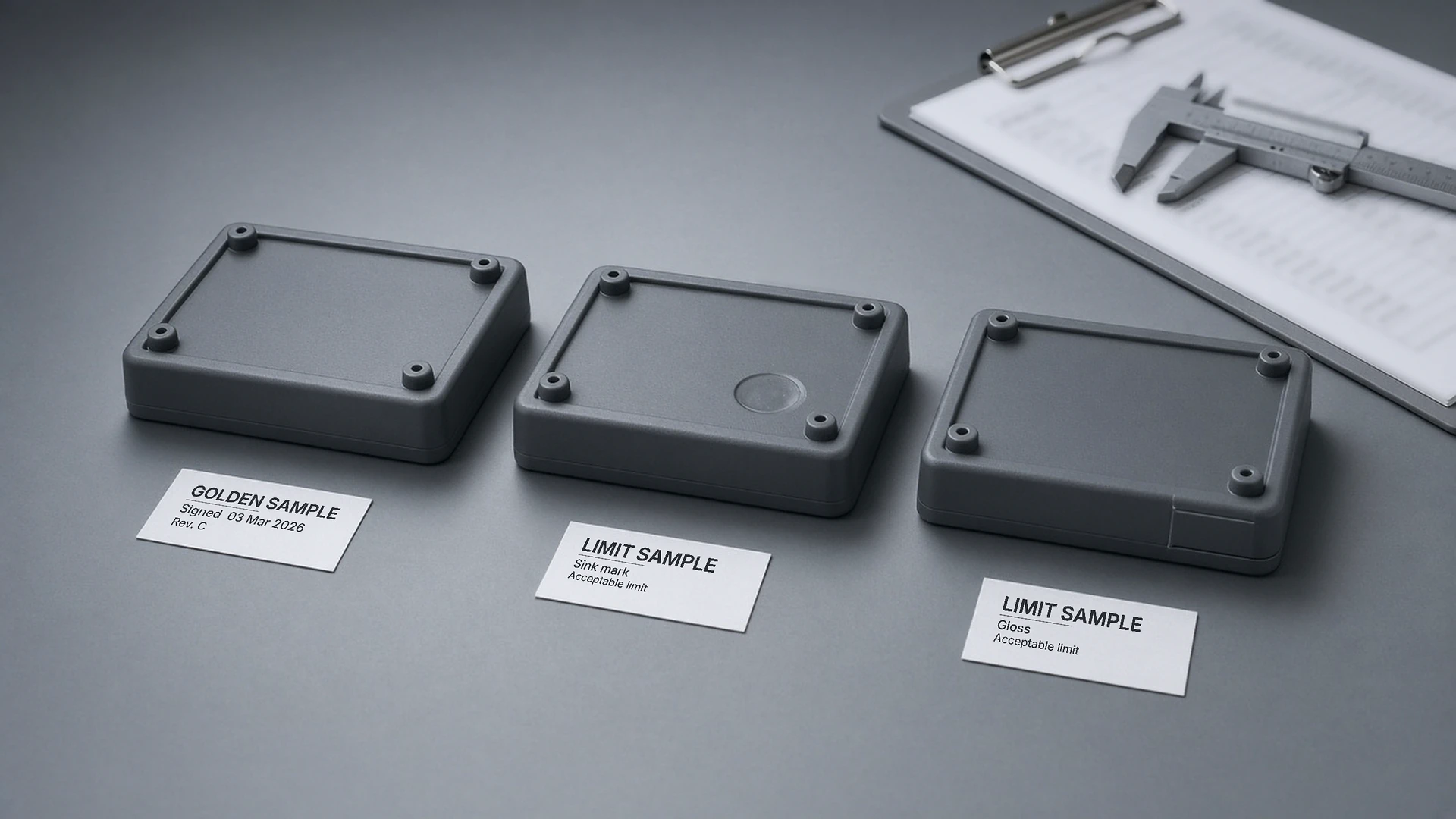
Example illustration, not a ProteForm part or project.
Golden sample vs T1 sample vs first article
These three get mixed up because they can look like the same part sitting on a bench. They answer different questions.
| What it is | What it answers | What it is not |
|---|---|---|
| T1 sample | The first parts sent from a new or recut tool, used to find what still needs work | A production standard. T1 is often still mid-correction: process not settled, texture not cut, color not final |
| First article (FAI) | A formal check that production-representative parts meet the drawing, with a report you approve | A promise that every later carton will match. It proves the process can make a correct part |
| Golden sample | A signed, labeled part that represents the agreed standard for later lots: appearance, feel, and, for assemblies, fit and pack | A substitute for a toleranced drawing, or a prettier piece pulled from a later run |
| Limit sample | A signed part that shows the worst condition you will still accept for a named defect on a named face | A golden sample. If you treat the limit as the target, production will drift toward it |
Pick the golden sample from parts that already passed first article, or from a later trial that used the intended resin, process and finish. Signing a raw T1 as the golden sample is how you lock in a process that was never stable. If T1 failed, fix the cause first; our guide on what to do when T1 samples fail is the decision path. For what an FAI report should contain, use sample approval and first article inspection.
Keep the FAI report and the golden sample together. The report is the numbers. The sample is the thing you can hold.
Limit samples: the worst acceptable sink, gloss, color and flash
A golden sample shows the standard you want. A limit sample shows the line you will not cross. Words like “slight sink” or “minor flash” do not travel well. Two inspectors will read them differently. A marked part does not.
Use a separate limit sample for each defect that actually shows up on your part and is hard to describe in writing. The usual set for a visible molded part is:
- Sink on a named face, often opposite a rib or boss.
- Gloss or texture mismatch, especially next to a gate or across a texture change.
- Color, judged under the light you already agreed, not under a phone flash. See plastic color matching for the reference, the light and the master plaque.
- Flash or gate vestige, with the face and the maximum you will accept marked on the part.
Mark the defect. A part with five possible marks and no arrow is not a limit sample; it is a debate. Label it as a limit, not as “golden,” and say which face and which defect it covers. Write the viewing distance and light next to it, or point to your cosmetic inspection criteria. The sample backs up that document. It does not replace it.
Do not use the limit as the production target. The golden sample is the target. The limit is the last acceptable part. If the shop starts matching the limit because it is easier, you will spend the next lots arguing about a drift you already allowed.
When you need them
You do not need a sealed sample kit for every hidden bracket. You do need one when people will disagree later, and the cost of that disagreement is high.
- Cosmetic parts. Class A faces, consumer housings, anything a customer will look at every day. If you have not written surface classes yet, do that first, then pick the samples.
- Color. Brand colors, parts that sit next to each other, or a match to an old supplier’s parts. A signed plaque or part, stored away from light, is the only reference that still works six months later.
- Assemblies. Snaps, screws, a lid that has to close, a bag and a carton that have to match the packing spec. A single molded piece will not settle those arguments. See finished assembly when the sample is a built and packed unit.
- Changing suppliers, or moving a tool. The new shop has never seen what you accepted. A labeled set is faster and fairer than a folder of photos and a verbal “like last time.”
They also help after a long gap in production, after a resin or colorant change, or when a third-party inspector will see the lot for the first time. If none of those apply and the part is fully defined by a drawing, you can skip a formal golden sample and still be fine. Do not skip it to save a conversation, then try to invent the standard at the dock.
How many sets, who signs, and how to label them
The usual setup is three identical sets: one at the factory, one with you, and one with the inspector (your own, or a third party you appoint). If the mold has more than one cavity, treat each cavity as its own part. Either include every cavity in each set, or record which cavity is the reference and why the others were not kept. “A mix from the tool” is how one cavity silently becomes the standard for all of them.
Who signs matters. The sign-off should be someone on your side who can accept product, and a named person at the factory who owns quality or the project. A signature with no name, or a WeChat “OK” under a photo, will not help you in six months. Date it. If a concession was granted (a sink you will live with, a dimension on a written deviation), attach that note to the sample record, not just to an email.
Put this on the label, or on a tag that stays with the part:
- Part number and drawing revision.
- Whether it is a golden sample or a limit sample, and for a limit, the defect and the face.
- Cavity number, and color or texture if more than one exists.
- Date signed, and the names (not only a stamp) of both sides.
- The FAI or trial report it belongs with, if you have one.
Seal it or bag it so a well-meaning operator cannot swap it for a “nicer” piece later. That swap happens more often than people admit, usually because the official sample looks a bit tired next to a fresh shot.
Send drawings and your sample plan for a quote
Send the model or drawing, the material, and any sample or cosmetic standard you already use. If you do not have a plan yet, say which faces, colors or assembly checks matter. We work with long-term partners at Chinese factories and match the plant to the part, then help you agree golden and limit samples with that plant before production lots start.
Storage: one set each at the factory, the buyer and the inspector
Three sets only work if they stay the same set. Keep each one in a known place, away from sunlight and shop traffic, in a bag or box that names the part. Write down where it lives. A sample that “should be in the QC office” is often on someone’s desk, or already gone.
The factory set is the one most at risk. It is close to the press, and it is tempting to use it as a handling demo or to replace it when it picks up a scratch. The buyer set is the one you will pull out when a lot is disputed. The inspector’s set is the one used on the day of a visit, so it has to be the same revision, not a spare from a later shipment.
When someone needs to compare, they compare against their own sealed set, under the agreed light, not against a photo of someone else’s set. If two sets no longer match each other, stop and find out which one changed before you judge a production lot.
Shelf life: color drift, UV aging, and when to replace
Plastic samples are not permanent. Color can drift. Some resins yellow. UV from a window will fade a plaque that looked perfect when you signed it. Soft materials can change feel. A scratched or dirty sample is a bad reference, because the next inspector will not know what was original and what happened in storage.
Agree a review, not a silent forever. A practical rule is to compare the three sets to each other on a schedule you write down, and whenever you start a new lot after a long pause. Replace the set when:
- The drawing, color, texture or assembly revision changes.
- The sets no longer match each other, or a sample has faded, cracked, warped or picked up damage.
- You granted a new concession, or you tightened a limit, and the old part no longer represents the line.
Sign and date the new set the same way as the first, and retire the old one so it cannot come back as “the sample” in a later argument. We will not invent a number of months that fits every resin and every warehouse. The review interval is yours to set. The failure mode to avoid is a faded buyer sample being used to reject a lot that still matches the factory set, or the other way around.
Using them with AQL and pre-shipment inspection
A golden sample and a limit sample tell the inspector what to compare against. An AQL plan tells them how many pieces to check and how many defects fail the lot. You need both. A sample with no sampling plan leaves the inspector guessing how far to look. A sampling plan with no sample leaves them guessing what a defect is.
Write the plan against the signed sample and the drawing, then use it at pre-shipment inspection. Cosmetic calls should be judged against the limit sample, under the same light and distance you used when you signed it. Dimensions still go to the drawing. Function and packing go to the signed assembly sample if you have one.
Do not ask a pre-shipment inspector to invent the standard. If the sample is missing, or it is the wrong revision, the visit will only record opinions. And do not treat a clean first-article report as a reason to skip the lot check. The sample is the bridge between those two steps, not a replacement for either one. We will not pick an AQL level for you and call it the standard. Set the levels and the defect classes for this part.
Signed samples for assemblies: function, fit and packaging
A molded piece can be in spec and the assembly can still be wrong. If you buy a built unit, sign a built unit. That sample should show:
- Function: a snap that holds, a lid that closes, a hinge or seal that works the way you accepted, and any go/no-go check you already use.
- Fit: screw seats, clips, inserts, and the gap or flush condition you will live with. If a torque, adhesive or press fit matters, write it on the record that travels with the sample.
- Packaging: bag, label, foam, carton marks and how the unit sits in the box. A correct assembly in the wrong carton is still a failed shipment.
This matters more when more than one plant is involved, or when you consign parts into an assembly shop. The signed unit is what the pack-out line and the inspector share. Our finished assembly page covers how that work is scoped. The sample is how you keep the scope from drifting after the first good unit ships.
What to check first when production and the sample disagree
Stop before anyone recuts steel, rejects a whole lot, or says “ship it, it’s close.” Work through this list. It is cheap, and it catches most false fights.
Confirm you are holding the right sample.
Match part number, revision, cavity, color and whether it is golden or limit. A surprising number of disputes are a Cavity 2 part judged against a Cavity 1 sample, or a new color judged against the old one.
Look at the sample itself.
Has it faded, yellowed, been scuffed in storage, or been quietly replaced? Compare your set with the factory set if you can. If the references disagree, fix that before you judge the lot.
Use the same light and distance you used at sign-off.
A phone photo, a window, and a light booth will not agree. Color and gloss fights that vanish under the agreed light were never a process issue.
Split cosmetic from dimensional and functional.
A sink or a flash mark is a limit-sample question. A hole that will not take a screw is a drawing question. Do not let one waive the other.
Ask what changed in the process.
A new resin lot, a different press, more regrind, a worn shut-off, a new operator, or a packing change can all move a lot off the sample. If the process changed and nobody updated the sample, you are not looking at a mystery. You are looking at an unapproved change.
If production looks “better” than the golden sample (higher gloss, a different shade, a sharper edge), do not quietly accept it as an upgrade. It may be fine, but it may also be a process shift that will not hold, or a finish you never approved against the mating parts. Record it, and decide whether to update the sample and the criteria, or to bring the process back.
A signed sample does not replace a toleranced drawing
This is the limit that gets skipped, and it is the one that causes the expensive fights. A golden sample is a physical reference for things a drawing describes badly: how much sink you will accept, what the texture looks like, how a snap feels, how a unit is packed. It is not a license to ignore numbers.
Dimensions, datums and fits still come from the released drawing. If a signed sample is slightly outside a tolerance, that does not move the tolerance. You either correct the process, or you write a deviation for that balloon, that value and that reason, and you keep the deviation with the sample record. If the drawing and the sample disagree and there is no deviation, the drawing wins on the dimension. The sample wins only on the appearance or handling condition it was signed to represent.
Do not use a flattering sample to hide a loose print, and do not use a tight print to reject a cosmetic condition you already accepted on a limit sample. Get both documents pointing the same way before the first production lot is packed.
When this isn’t a job for us: if you only need someone to hold a sample for a shipment we are not coordinating, or to settle a commercial waiver on a lot already at the dock, that sits with you and the current supplier. If the tool has never been sampled and you want a signed “golden” part from an unapproved process, we will not treat that as a standard.
Frequently asked questions
What is the difference between a golden sample and a limit sample?
A golden sample is the agreed standard: the part you want production to match. A limit sample is the worst condition you will still accept for a named defect on a named face. Keep them labeled as different things. If the shop starts matching the limit, the standard has already slipped.
Can I sign T1 parts as the golden sample?
Only if those parts were made with the intended resin, process and finish, and they already represent what you will accept in production. Early T1 is often still mid-correction. It is safer to sign the golden sample from parts that passed first article, or from a later trial that used the production setup. If T1 failed, fix that first.
Does a signed sample replace a toleranced drawing?
No. Use the sample for appearance, feel, fit and packing, the things a drawing describes badly. Dimensions still come from the drawing. If a signed part is outside a tolerance, write a deviation or correct the process. Do not let the sample quietly rewrite the print.
Send drawings and your sample plan for a project review
Attach the drawing, the material, and any golden or limit sample you already have, or tell us which faces, colors and assembly checks you want locked in. We’ll review the design, match the work to a partner factory, and help you agree the samples and the inspection plan before the first lot is packed.