
Plastic manifolds, fittings, valve bodies and pump housings carry or distribute a fluid through channels, ports and sealing faces. They are chosen when weight, corrosion, electrical isolation or cost at volume favors a polymer over metal. This page covers that part type: materials and processes usually reviewed, design points for channels and joints, and what to send. Two published reviews of related work sit on the case-study pages for a sealed polycarbonate fluid manifold and an acrylic manifold made by vacuum casting; those are examples of a review, not catalog SKUs. We run the job with a factory in China we know well. The manifold images on this page are studio renderings based on real machined parts, shown for reference, not catalog items.
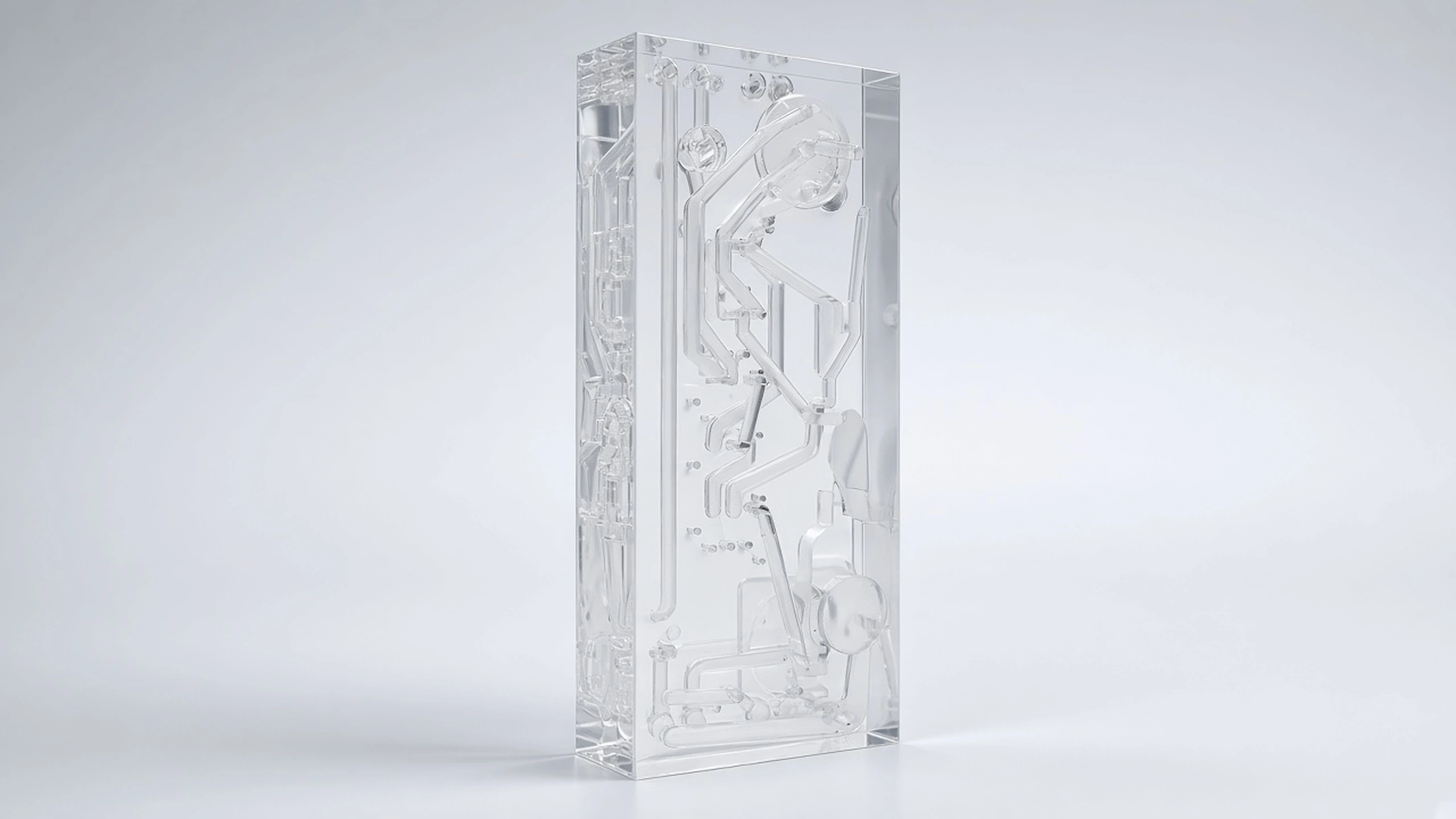
Parts in this group
| Part | Typical questions |
|---|---|
| Manifolds and distribution blocks | Internal channels, port threads or barb fittings, leak test, mounting |
| Elbows, tees, connectors | Standard or custom geometry, weld or thread, appearance if visible |
| Valve and pump bodies | Pressure, chemical, moving seals, insert-molded seats or shafts |
| Filter bowls and small reservoirs | Clarity if the level must be seen, chemical, venting |
| Sensor ports and sample blocks | Sealing of a probe, dead volume, cleanability if you require it |
Materials usually reviewed
| Material | Where typically used | Notes |
|---|---|---|
| PP and HDPE | Water, many chemicals, welded assemblies | Readily welded; see PP vs HDPE. |
| Polycarbonate | Clear manifolds, some laboratory-style blocks | Tough and clear; chemical limits must be checked. The sealed-PC case study is an example of this duty. |
| Acrylic | Clear visual blocks, often machined or cast | Excellent clarity; more brittle than PC on impact. |
| Nylon, PBT, PPS | Connectors, under-hood or warmer fluid systems | Moisture (nylon), heat and fluids should be named. |
| PEEK, PTFE | Aggressive chemicals or higher temperature | Often machined at low volume. See PEEK vs PTFE. |
| Rigid PVC | Some fittings and ducts | Solvent cementing and chemical limits depend on the grade. |
Send your manifold or fitting for review
Process choice
| Process | When it is typically reviewed |
|---|---|
| CNC machining from plate or block | Clear manifolds, low volume, intersecting drilled galleries. Common in PC, acrylic, PEEK, PTFE, PP. |
| Injection molding | Repeating fittings and bodies at volume, including threads and barbs |
| Vacuum casting | Small clear or opaque lots before a hard tool, as in the acrylic case study |
| Welding of molded or cut pieces | PP and PE manifolds built from parts; see hot plate and vibration welding and laser welding |
| Insert molding | Threads, seats or metal tubes molded into the body |
Channels, seals and pressure
- Show every flow path, port and unused cavity in the CAD, including how galleries are plugged if they are drilled.
- State the fluid, concentration, temperature, pressure and whether the duty is continuous or cyclic.
- Define the seal at each port: O-ring gland, gasket, thread sealant, weld or a bonded joint. See seals and gaskets.
- Avoid sharp inside corners in pressure parts where a crack can start.
- If the part must be clear, say whether you will accept machine marks, or whether a polished or as-cast face is required.
- Plan leak testing: air-under-water, pressure decay, or a fluid test, with a limit. A visual “no leak” is not a method.
- For welded manifolds, design the joint and the flash path, and say whether flash may sit in the flow.
Assembly and cleanliness
Ports, fittings and fasteners should be in the same RFQ as the block if you want them fitted. Thread-forming screws into plastic, metal inserts and bonded-in barbs have different limits; name the mating fitting. If you need a flushed or particle-limited part, define the clean-down and the inspection, and do not assume a standard shop wash meets it. Medical or potable-water documents, if required, are stated by you and confirmed on a named grade; this site does not treat a manifold as a qualified device.
Routes compared
| Route | Strengths | Limits |
|---|---|---|
| Machined block manifold | Flexible channel layout, excellent for clear prototypes and short runs | Cost per piece; plug points on drilled galleries |
| Molded fitting or body | Volume unit cost, molded ports | Tooling; late channel changes are expensive |
| Welded PP/PE assembly | Large or awkward shapes, chemical duty | Weld quality and flash in the flow must be controlled |
| Cast or vacuum-cast block | Appearance close to molded, modest quantities | Material and temperature limits of the casting resin |
What to include in an RFQ
- CAD with channels, ports and mounting, or a sample to remake.
- Fluid, pressure, temperature and the leak test you will use.
- Clarity, color and any cleanliness requirement.
- Whether fittings are supplied fitted, and the quantity.
Related: bottles, containers and tanks, the two manifold case studies, and the part-types catalog.
Threads, inserts and standards

Port threads may be cut, molded or provided by a metal insert. A molded plastic thread is economical at volume but is easier to strip than a metal insert if the fitting is removed often. Say how many times the joint will be opened, and whether the mating fitting is metal or plastic. If you require a named thread form, put it on the drawing; informal references to “standard hose thread” waste a review cycle. Inserts can be molded in or installed later; see insert molding and heat staking.
Clear blocks and appearance

A clear manifold is often used so flow or air can be seen. Machining marks, plug welds and scratches all show. Agree a viewing standard: which faces are optical, which may be as-machined, and how the part is packed. Solvents used to clean a PC or acrylic block have to be compatible; a cleaner that is fine on PP can craze PC. The published case studies are useful as a discussion of those choices, not as a promise that the next part will look the same.
If the manifold is one of several in a family, share the whole family in the RFQ. A common port pattern or a shared tool insert can reduce cost, but only when the flow paths genuinely allow it. Late addition of a fifth port to a four-port block is usually a new part, not a small edit, once a mold exists. Machined blocks are more forgiving of that kind of change, which is why they remain the default while the circuit is still moving.
Frequently asked questions
What plastic is typically used for a fluid manifold?
PP and HDPE for many chemicals and welded assemblies; PC or acrylic when the block must be clear; nylon, PPS, PEEK or PTFE when heat or aggressive fluids lead.
Can a manifold be machined from a solid block?
Yes. Machining is the usual low-volume route, including intersecting drilled galleries in PC, acrylic and high-performance plastics.
Are your case studies products for sale?
No. They are published examples of a design review. A new manifold is quoted from your files, not from those pages as SKUs.
How should leak tightness be specified?
Give a test method and a limit (for example a pressure and a hold time). A generic request for a “sealed manifold” is not enough to quote against.
Can ports be welded or insert-molded?
Yes. Welded PP/PE joints and insert-molded threads or tubes are reviewed when you include them in the design and the RFQ.