
You’re about to send a request for quotation, and you want numbers you can actually compare. A drawing that says “plastic” in the title block and a quantity of “TBD” will get replies, but they will not be the same job. This page is what should be included in an RFQ for custom plastic parts so a coordinator or a shop can review the design and quote the work you think you asked for.
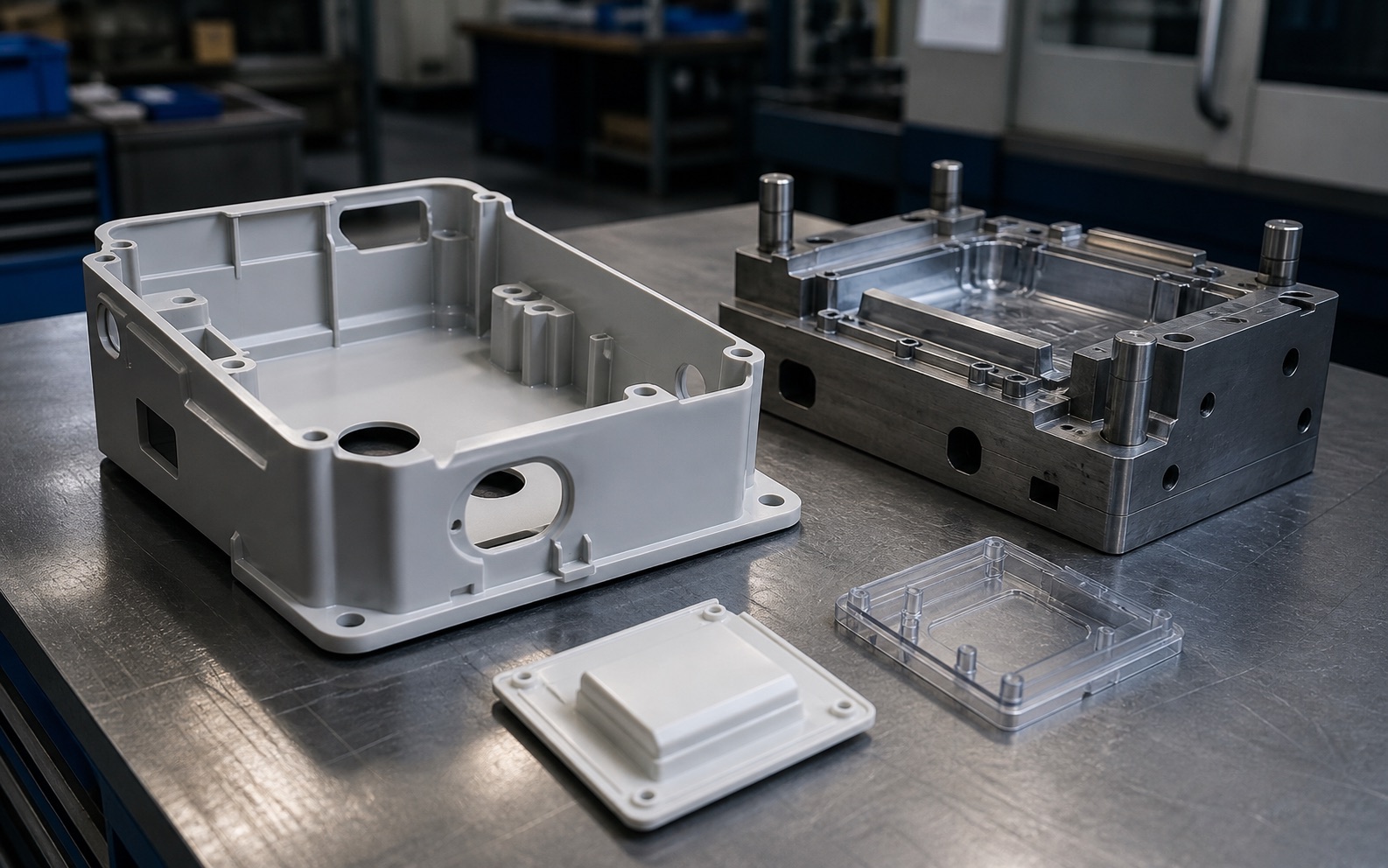
Generic illustration, not a part ProteForm made.
Why does a thin RFQ produce quotes you cannot compare?
Each shop fills in what you left blank. One assumes a commodity resin and a simple cosmetic standard. Another assumes the engineering grade you meant and a first-article pack.
That is why what should be included in an RFQ is not a formality: the tooling line, the piece price, and the lead time have to refer to the same part, material, and acceptance standard. A complete pack also makes a DFM review possible. See the DFM checklist for injection molded parts for what to fix on the design. This page is what to send so the quote is even about that design. You do not need a perfect pack to start, but you do need to label what is still open.
What files and revision data should go in the pack?
Send the current 3D model, a dimensioned 2D drawing if you have one, and the revision of both. If the model and the drawing disagree, say which one governs. If some dimensions, materials or notes are still provisional, mark them. A STEP or similar neutral file is usually enough to start a process and tooling review. For the file types themselves, see which CAD formats to send with a manufacturing quote. If all you have is a physical part, see what to send when you have a sample but no CAD file. If the pack is sensitive, say whether an NDA has to be in place before the file is opened; see when to have a manufacturer sign an NDA before you send CAD.
Name the files so a stranger can tell the part and the revision apart. Include insert or hardware models that are part of the job, even if you will supply the metal. Say whether this is a new tool, a change to an existing tool, or parts from a tool that already exists. Do not send a dozen unrelated assemblies “for context” if the quote is for one part.
How should you specify material if the drawing only says “plastic”?
If the drawing says “plastic,” the RFQ has to do better. Give the grade, or the resin family plus the requirements that will force the grade: temperature, chemicals, strength, flame rating, contact rules, outdoor UV, or a color and finish that only some resins can hold. If you already have an approved grade and an alternative, list both. If the resin is buyer-supplied, say so. “ABS or equivalent” is a starting point, not a specification, unless you add a property or a test.
If color is part of the job, say whether you need a matched color, a standard color, or a natural resin you will paint. Color and texture belong next to the material, because they change the tool and the process, not only the pellet price. If you have not chosen a material, say so and describe the duty; how to choose a material when the drawing only says plastic goes through that step by step. Do not leave the material blank and then compare piece prices as if everyone assumed the same resin.
What quantities and process information actually help?
Separate the quantity you need now from the quantity you expect later. A 50-piece first build and a 10,000-piece year are different tools and different processes. Give both, even if the annual figure is a range. If you only state the sample quantity, you will often get a prototype-tool quote. If you only state a large annual number, you may get a multi-cavity steel tool you are not ready to fund. If you already know the process, say so. If you do not, say what you are trying to learn. For a wider look at buying the work in China, see sourcing plastic parts from China.
Target timing belongs in the pack as a request, not as a demand dressed up as a fact. “We need T1 by this date if it is realistic” is useful. “Lead time must be X days” with no tool type and no approval path invites a number someone cannot keep.
| Put this in the RFQ | Why it changes the quote | If you leave it out |
|---|---|---|
| Current model and drawing, with revision | The tool and the DFM review follow the geometry you intend to freeze | Shops quote different revisions |
| Material grade, or the duty that will force it | Resin, drying, shrink, and sometimes the steel all move with the grade | Piece prices assume different resins |
| Sample quantity and expected production range | Cavity count, steel, and process follow volume | You get a soft tool priced as production, or a production tool you did not ask for |
| Cosmetic class, color, texture, and critical tolerances | Polishing, texture, color matching, and inspection sit in both tool cost and piece price | One shop quotes a utility finish; another quotes a show face |
| Inserts, secondary ops, inspection, Incoterms, packing | Bought-in hardware, finishing, and freight terms change the work being priced | The cheap quote is EXW and unfinished; the other already includes them |
Send your pack for a plastic parts quote
Send the model or drawing, the revision, material or the duty that will force it, quantities, and how you will accept the part. If some of that is still open, say so. We’ll review the design for manufacture, confirm which supplier would make it, and only then quote. We do not need a perfect production data pack to start a review.
What about cosmetics, tolerances, color, and inserts?
Say which faces are cosmetic and which can be a utility finish. If you have a texture standard, a polish expectation, or a “no witness marks on this face” rule, put it on the drawing or in the RFQ. “Good appearance” is not a class. Tolerances should follow function. Mark the fits, sealing faces, and datums that actually matter, and leave the rest to a general title-block tolerance that plastic can hold. For how to set those numbers, see what tolerances should you put on a plastic or CNC drawing.
List inserts, overmolded substrates, threads, printing, painting, welding, machining after molding, and any test the part must pass. If you will supply the inserts, say how they arrive and who is responsible if a short lot stops the press. Say whether you need a matched color, a clear part, a painted finish, or a printed mark, and whether that work is in this quote. If color is still open, say it will be agreed after first shots.
Inspection, testing, Incoterms, and packing
State how you will accept the first article and the production lots: dimensions, cosmetics, a function test, a material certificate, or a documented inspection pack. If you need a formal first-article report, an outgoing check, a photo set, or a sealed sample, say so. A shop that assumed “we measure a few dimensions” and a shop that assumed a full layout are not quoting the same work.
Name the Incoterm and the destination if you want freight in the number, or say the quote should be ex works so you can compare manufacturing cost on its own. The same part, quoted DDP to your door and quoted EXW at the shop, will not match. If packing is special, include it. Target timing is a request. Include a real constraint if you have one, and do not require a date that assumes a steel and a frozen design you do not yet have.
How this works if you send the RFQ to ProteForm
We work with a network of factories in China we know well. You can send the pack through the request a quote form, or by email if you already have a thread with us. If you are writing to a supplier for the first time, see how to write an RFQ email for custom plastic or CNC parts for the cover email that goes with this pack. We review the design for manufacture, confirm which supplier would make it, and only then quote. We do not forward your files to a long list of shops. If the pack is incomplete, we will tell you what is missing and what we would have to assume. If you are new to this sequence, the buyer’s playbook is the wider set of pages around RFQs, tools, and inspection.
When we are not the right fit
If you need a catalog or stock part, or a reseller to fill a distributor bid form, we are the wrong door. If you have no model, no drawing, and no requirements, we will not invent a part in order to print a number. A legal or government RFQ template, or a bid-compliance pack for a public tender, is not our work. We also decline requests to “just beat this price” when the competing quote has no files, no grade, and no process attached.
What to include in an RFQ
- Current 3D model and, if you have one, a dimensioned drawing, with revision and a note on which file governs.
- Material grade, or the duty and tests that will force it, plus color, texture, and whether resin is buyer-supplied.
- Quantity for the immediate build and the expected production or annual range, and the process if you already know it.
- Cosmetic faces, critical tolerances, inserts, and any secondary operations or tests.
- Inspection expectations, Incoterms and destination if freight is in scope, packing notes, and target timing as a request.
- Your NDA draft, if a signature has to come before the CAD is opened.
Frequently asked questions
What should be included in an RFQ for plastic parts?
The current model or drawing and its revision, the material or the duty that will force it, sample and production quantities, cosmetics and critical tolerances, inserts and secondary operations, inspection, and the ship term if freight is in the number. Label anything that is still open rather than leaving it blank.
Can I get a quote if the drawing only says “plastic”?
You can start a review if you describe the duty (heat, chemicals, strength, appearance). A firm piece price still needs a grade, or an agreed assumption written on the quote. Otherwise the numbers you collect are not comparable.
Do I have to send a STEP file?
A serious tool or piece-price quote needs enough geometry for a DFM review. A 2D drawing can be enough for a first process opinion on a simple part. If the design is sensitive, say whether an NDA must be signed before the file is opened.
Why are the quotes I already have so far apart?
Often the shops did not assume the same resin, cavity count, finish, volume, inspection, or Incoterm, because the RFQ left those items open. Fix the pack and ask them to requote the same job before you pick a winner on price alone.
What will ProteForm do with my RFQ?
We go through it, tell you which factory would make it, and then quote. We do not spray the pack across a long list of shops. If something required to price the job is missing, we will tell you what we would have to assume, or we will ask you to send it.
Send your pack for a plastic parts quote
Send the model or drawing, the revision, material or the duty that will force it, quantities, and how you will accept the part. If some of that is still open, say so. We’ll review the design for manufacture, confirm which supplier would make it, and only then quote. We do not need a perfect production data pack to start a review.